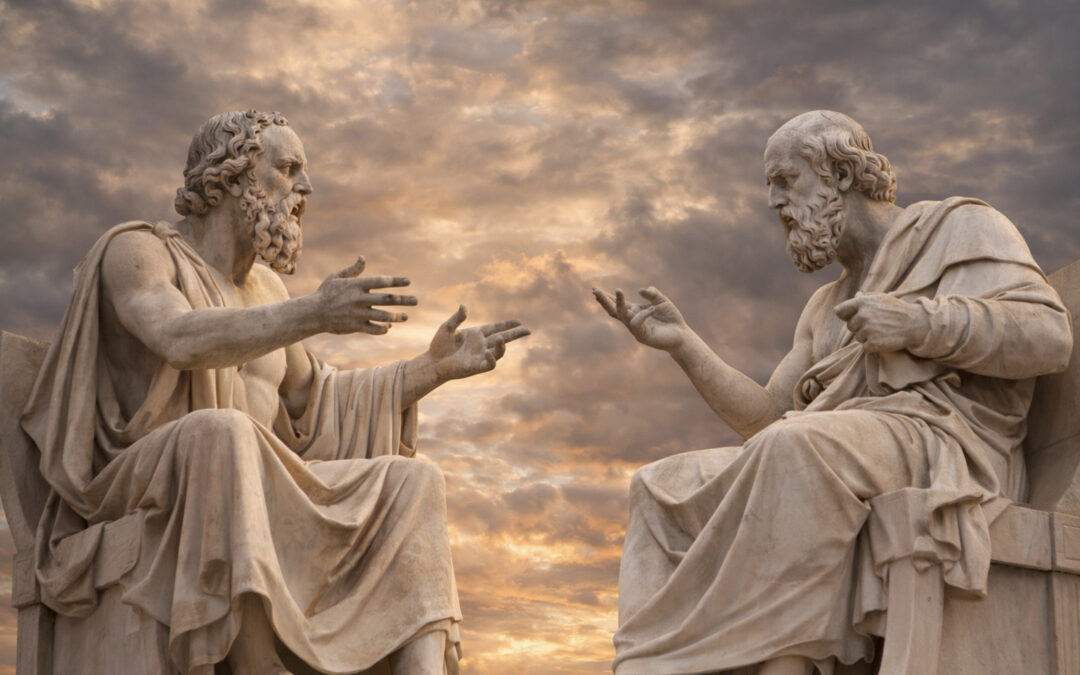
“People will choose unhappiness over uncertainty.” –Tim Ferriss
We crave certainty. It makes our lives easier. We spend time planning for the future. These measures give us a sense of control. We leave no room for luck. Our moves are measured and calculated, designed to produce specific (desired) results.
Despite all our precautions, there comes a time when things don’t go as planned. Even with careful planning, a single unexpected event can leave us feeling exposed. Anxiety sets in, and we start questioning what we could have done differently.
What makes such events even more unnerving is that they carry an element we don’t immediately understand. It takes time for them to become familiar, and much longer for us to grasp what could have caused them.
Moments like these, when the unfamiliar unsettles us, are far more common than we might like to admit.
The Eclipse and the Cloak
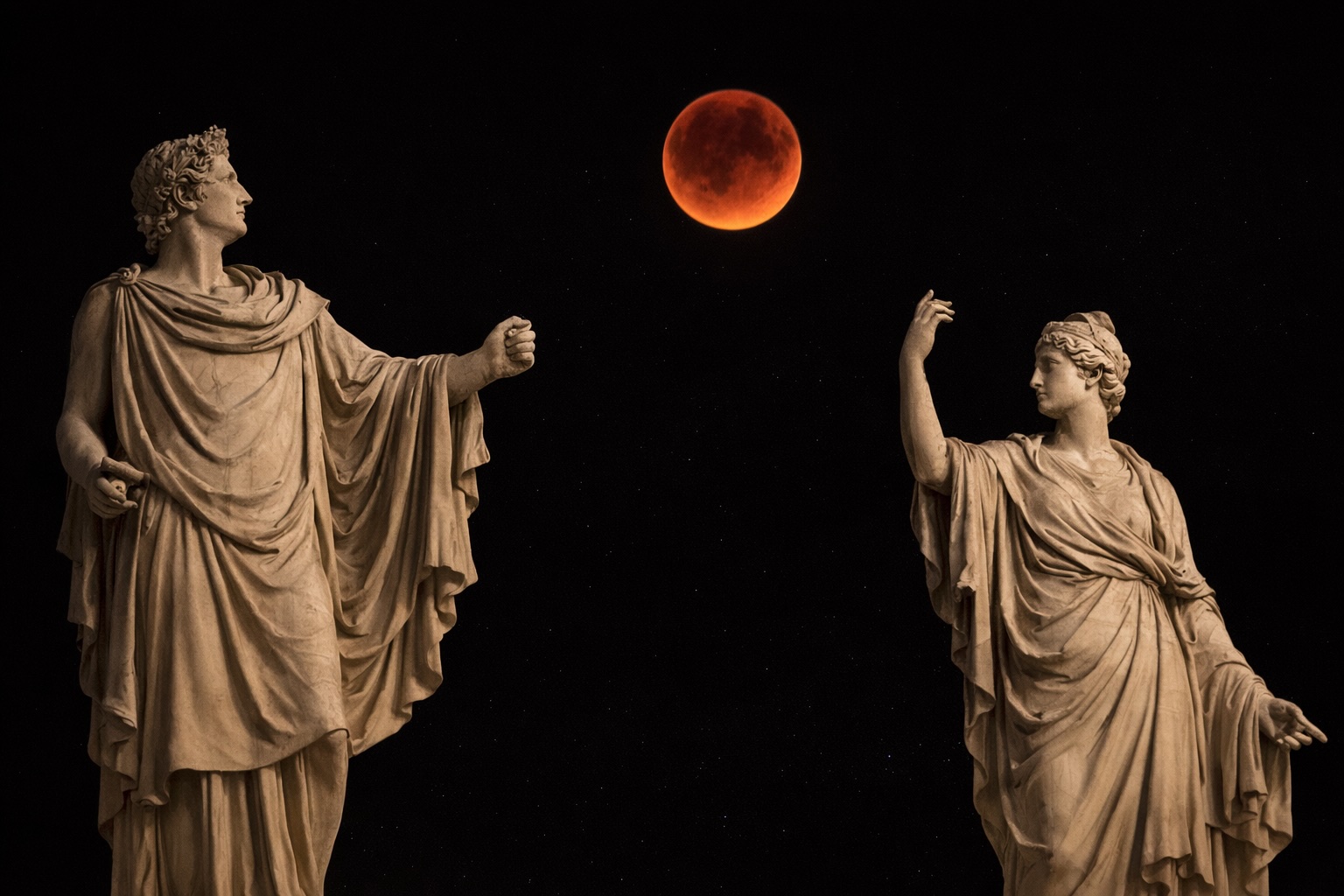
Before setting sail on a naval expedition, Pericles, the Athenian statesman, found the helmsman in fear. The sky had darkened. It was an eclipse. It was taken as a bad omen.
In an attempt to remedy the situation, Pericles took out his cloak and covered the man’s eyes.
“Then what’s the difference between the two events?” Pericles replied. “Other than the sun being eclipsed by a larger cloak?”
In that moment, the man was freed, if only briefly, from his deep-rooted anxiety.
What Pericles did was simple. Instead of explaining the eclipse or analyzing the seaman’s dread, he contained the fear through a simple gesture. In doing so, he made the unfamiliar feel familiar. He gave it, in a way, a name. Using something the seaman could hold onto, if only for a moment.
We encounter similar ‘eclipses’ in our lives. These can take many forms, from market crashes to personal setbacks. The feeling they evoke is a subtle dread, not the panic of immediate danger, but the same kind of fear the seaman felt when the sky darkened during the eclipse.
Faced with the unknown, we try to make reality more bearable by weaving narratives. We craft tales and tell stories to soften the uncertainty surrounding it.
Framing the Unknown
It isn’t easy for us to deal with complexity, uncertainty, and outcomes we cannot control. New business ventures might not go the way we want them to. Halfway through a personal goal, we find ourselves pivoting because things didn’t turn out as we had expected or hoped. A portfolio, no matter how well diversified, will still take a hit during times of heightened economic and geopolitical uncertainty.
Like Pericles, we reach for frameworks, strategies, and different plans to wrap our heads around this ambiguity. When events unfold differently than anticipated due to the underlying uncertainty, we tend to refer to that possibility as risk. It is our way of defining the unknown, naming and framing it, and finding ways to strategize, plan, and hedge against it.
The Story of Risk
Our relationship with uncertainty and risk has evolved over time. In Against the Gods: The Remarkable Story of Risk, Peter Bernstein traces the evolution of these concepts. In ancient Greece and Rome, the forces we now separate into uncertainty and risk were seen as Tyche, Fortuna or Lady Luck. Measures could be taken to manage that luck, but these forces were ultimately seen as fateful events, not something people could actively change. They were conditions to navigate rather than eliminate. Over time, our relationship to these forces, and the stories we told about them, changed.
“You must wager; it is not optional” –Pensées, Blaise Pascal
Blaise Pascal’s wager reflects the human impulse to calculate our risk and assign probabilities to uncertain outcomes, especially when the stakes are high. Pascal’s work was instrumental in laying the groundwork for modern portfolio theory. He co-founded probability theory within the framework of games with known odds and unknown outcomes. He imagined games of dice where every roll of the dice had an equal chance. What was unknown was when the game will end.
His framework yielded a consequential “wager” with an unimpeachably reasonable result. You may or may not believe in God. God may or may not exist. If you believe and God exists, you have infinite gain. If you don’t believe and God exists, you have eternal misery. If God doesn’t exist, the gains and losses are quantifiable (some psychological comfort, some lifestyle costs). Within this framework, even if the probability of God existing is small, the potential payoff is infinite. Why would anyone not believe in God?
It is impossible to argue with this logic. The problem is that markets, and life in general, have a much more complex set of outcomes than a simple yes or no about the existence of God. It is not black or white. There are more than 50 shades of grey.
“It is better to be vaguely right than exactly wrong” –Carveth Read
Through the development of probability theory after Pascal, we could think about the likelihood that things may not go as planned. Over decades of research, this led to the development of precise mathematical tools, methodologies, models, and eventually sophisticated software to put a number on risk, and the probabilities associated with it.
Like Pericles’ cloak, we imposed frameworks around uncertainty, establishing certain parameters we called risk. These included specific mathematical formulations, helping us make more informed decisions across different personal and professional spheres. We quantify risk and factor it into equations designed to optimize returns given our tolerance. Wonderful.
And these tools, calculations, and models work. Until they don’t.
They don’t fail because the frameworks are useless, but because underneath there’s uncertainty and complexity. Unlike Pascal’s wager, probabilities of each outcome are not predictable; and they may change at any time.
We may have managed to convince ourselves that we developed a sophisticated understanding of a framework to make decisions under uncertainty. But, essentially, all we did was to assume certain probabilities about events taking place.
Conflating Risk with Uncertainty
People often confuse risk and uncertainty. This is because uncertainty is difficult to define and measure. Yet it is precisely this distinction that Frank Knight placed at the centre of his classic Risk, Uncertainty, and Profit.
Knight argued that risk applies to situations where probability can be meaningfully and objectively measured: fire hazards, insurance losses, the failure rate of machinery. These belong to a world where, to a certain extent, past data could guide future outcomes. Risk can be priced, budgeted for, and incorporated into the fixed costs of running a business.
Uncertainty, however, resists this approach because it cannot be grounded in any reliable set of probabilities. Decisions such as expanding a factory, launching a new product, or starting a new venture unfold in conditions where no amount of data can capture the full range of possible outcomes. Managing these situations, Knight explains, requires judgement, one that relies on estimates, common sense, intuition, and incomplete information.
For Knight, this distinction implies a deep economic significance. Since true uncertainty cannot be eliminated completely, it makes possible entrepreneurship and the economic rewards that come along with it. Uncertainty prevents perfect competition: nobody has complete knowledge of the future, and everyone acts from a position of partial understanding in a dynamic world.
As a result, uncertainty cannot be precisely measured. It relies on estimates rather than exact probabilities and cannot be completely hedged away using models built on statistical assumptions. The unknown remains exactly that: unknown.
Faced with this reality, all we can really do is focus on what we can control. We often lean on the narratives that help us move through what we don’t know and can’t control. These stories do not eradicate uncertainty; they simply make it feel manageable.
The confusion of risk and uncertainty can have pernicious effects. An investor, faced with the complexities of the financial market, may tell themselves a good story about how real estate is a reliable investment in the long term. They would often end up having a large part of their wealth tied to real estate, even if portfolio theory would suggest that tying up too much of your wealth in a single type of asset increases your risks.
“We have now sunk to a depth at which restatement of the obvious is the first duty of intelligent men” –George Orwell, Facing Unpleasant Facts
Nassim Taleb became a celebrity after publishing The Black Swan in 2007. His timing could not have been more fortunate. Published at the eve of the global financial crisis, Taleb perfectly explained the perils of making the wrong assumptions about the probabilities of different outcomes. Wrapped in riveting prose about “normal distributions” and “fat tails”, Taleb simply stated that modern portfolio theory is flawed in its assumptions not that it is flawed in its formulation.
Taleb couldn’t provide a solution in The Black Swan. His answer is that it is impossible to predict outcomes, and bad things happen. So, you must hedge. A lot. Effectively his strategy was to buy insurance and wait for a disaster. In an interview he said his strategy cannot “blow up” but can only bleed to death. It did just that. Before publishing The Black Swan, he closed his hedge fund.
Instead of navigating uncertainty and the risk that comes along with our decisions and ventures, we told ourselves the story that we could tame uncertainty by naming and calculating risk. In doing so, we often create disappointment, not due to the events that happen, but because our stories stop holding together.
“The fault, dear Brutus, is not in our stars, but in ourselves”… –Shakespeare, Julius Caesar
For this reason we are so consistently surprised when ‘eclipses’ happen in the form of a market crash, business failure, a missed personal goal.
We say things like: “The experts said this was an unlikely event.” “The risk is factored in, and the models suggest this is the best course of action.” We treat them as failures of prediction because the models didn’t see them coming. What is unsettling in this case isn’t the event itself but the underlying uncertainty that gives rise to it.
When such unlikely events happen, it isn’t only that the model failed. Rather, the model breaks down in the face of true uncertainty. As Knight insists, risk and uncertainty belong to two different domains. Addressing them calls for a different kind of approach and set of skills. Uncertainty demands judgement, intuition, and common sense. These are not only technical but soft skills. They require tolerance of ambiguity and comfort with making decisions based on incomplete information without any guarantees.
This is why uncertainty generates a particular kind of anxiety. It’s not only the fear that things could go wrong, it’s rather the disappointment that our models didn’t hold. By trusting our models deeply, and believing that we are well hedged against risk, in the face of uncertainty we experience a profound loss of control in face of the unknown.
“The quest for certainty blocks the search for meaning. Uncertainty is the very condition to impel man to unfold his powers.” –Erich Fromm
But Knight offers us a silver lining. Uncertainty is what makes entrepreneurship, and innovation more broadly, possible, including both the potential rewards and losses that accompany it.
Dealing with uncertainty, as we have seen, benefits from cultivating skills that emphasize initiative, and high-agency. It includes questioning our assumptions, asking the right questions, shifting perspectives, sharpening common sense, and making decisions despite incomplete information. It entails a multi-disciplinary approach, a philosophical mindset, and the ability to approach the underlying problems from different angles beyond a strictly technical focus.
The ancient Greeks understood this intuitively. They didn’t try to eliminate uncertainty. They named it, and crafted their stories around it in a way that helped them move through it. Pericles didn’t control the eclipse, he put it in perspective. In a similar vein, we use models and frameworks to navigate uncertainty with clarity and confidence. But as we’ve seen, these tools can only take us so far. A better approach may lie not only in managing risk, but in learning to move through uncertainty with judgment, courage, and curiosity.